

A stock is not halal simply because the company sells a permissible product. Shariah compliance also depends on how the business is financed, where its incidental income comes from, what type of security you are buying, and how the trade is carried out.
NoorVest uses an AAOIFI-aligned framework with two central tests. The company's main business must be permissible, and its exposure to interest and other prohibited income must remain within defined limits. These tests require regular review because financial statements, business activities, and market values change over time.
This guide explains how that review works. It is educational and does not provide a religious ruling on a particular stock. Shariah methodologies and scholarly views can differ, so investors should follow a clearly identified standard and seek qualified guidance for their own circumstances.
Are stocks halal or haram?
Stocks cannot be treated as a single category. A common share represents an ownership interest in a company, as explained in the SEC's investor education materials.[1] That ownership is why many scholars permit ordinary shares when both the company and the transaction meet the relevant Shariah requirements.
The Fiqh Council of North America describes three broad categories of companies:[2]
- Permissible business and permissible finances. Shares are generally accepted when both tests are satisfied.
- Prohibited core business. Companies centered on conventional interest based finance, gambling, alcohol, pork products, or adult entertainment are excluded.
- Permissible core business with incidental prohibited activity. These mixed companies require business and financial screening before their shares can be assessed.
Most practical screening questions fall into the third category. A manufacturer may produce something permissible while carrying interest bearing debt or earning interest on excess cash. The purpose of screening is to measure those exposures against the limits set by the chosen methodology.
What makes a stock halal?
A useful review separates the decision into five questions:
- Does the security itself have a permissible structure?
- Is the company's main business permissible?
- Do the company's financial ratios pass the selected standard?
- Is prohibited income identified and purified through a documented process?
- Does the investor take ownership and trade through a permissible process?
Every question matters. A company may operate in a permissible industry and still fail its financial screen. A stock may also pass at the company level while being purchased through an interest bearing margin account, which introduces a separate concern.
Step 1: Confirm the type of security
This guide focuses on common stock, which represents an ownership interest in a company. Its value and potential return depend on the company's performance and how the market values the business. Other securities can work very differently and may require a separate Shariah analysis.
Preferred shares, conventional bonds, convertible notes, derivatives, options, and leveraged exchange traded products should not be treated as ordinary shares under another name. Some involve interest payments, fixed or preferential returns, embedded leverage, or contractual terms that raise distinct Shariah questions.
Confirm what you are buying before you assess the issuer. A familiar company name does not mean that every security issued by that company follows the same structure or meets the same Shariah requirements.
Step 2: Review the company's business activities
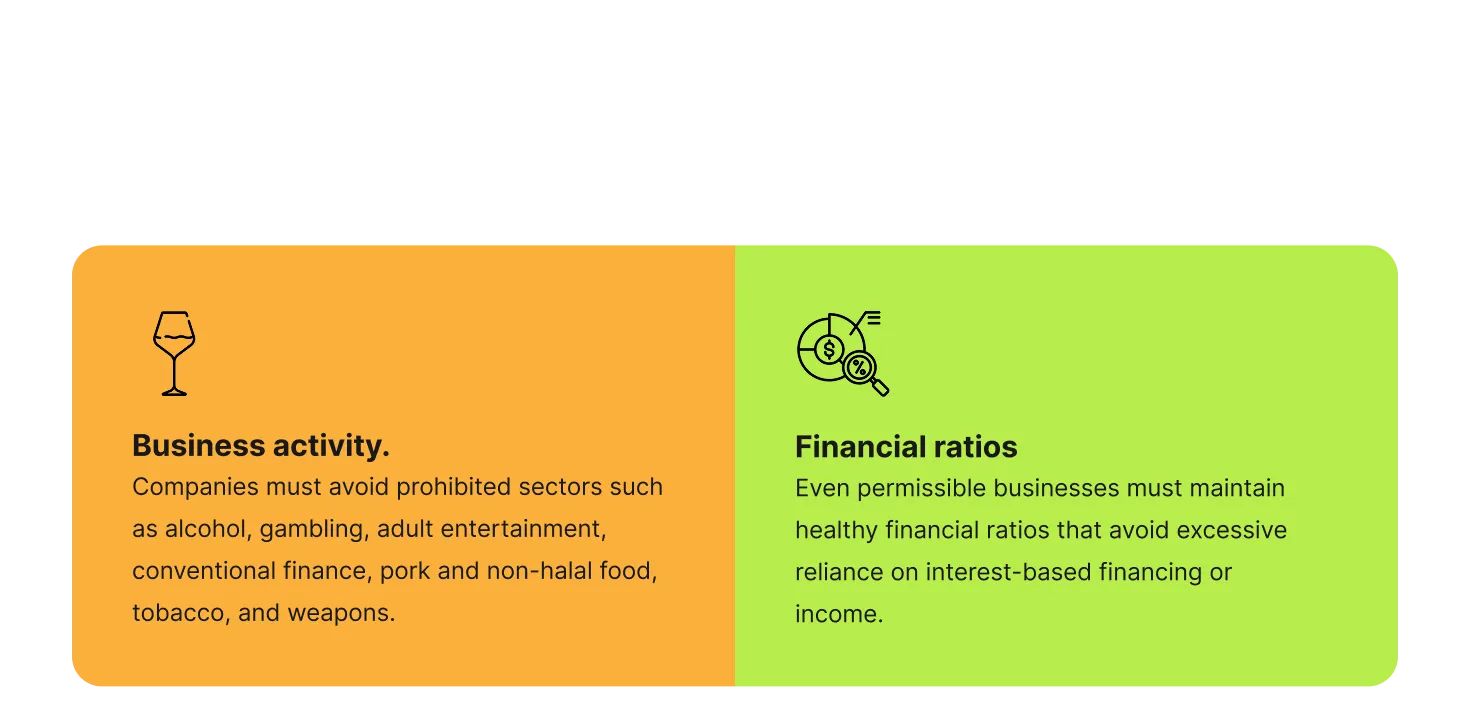
Begin with the company's actual activities and the sources of its revenue. NoorVest's AAOIFI-aligned approach excludes businesses centered on the following areas:
- Conventional banking, lending, and insurance
- Gambling and gaming
- Alcoholic beverages
- Pork and pork related products
- Adult entertainment
- Tobacco
- Recreational cannabis
- Weapons and other restricted military activities
- Other activities identified as noncompliant under the methodology
Industry labels rarely tell the whole story. Large companies may operate several business lines, own subsidiaries, or earn revenue from activities that are not obvious from the brand. A retailer may sell a small amount of prohibited merchandise. A software provider may serve clients in a restricted industry. Media companies often require a closer review of both content and revenue sources.
A careful business review should answer these questions:
- What products or services does the company primarily sell?
- Which activities generate most of its revenue and profit?
- Do any subsidiaries or joint ventures conduct prohibited activities?
- Is prohibited revenue incidental, or is it important to the business model?
- Does the selected methodology exclude the industry as a whole?
Use the company's filings rather than relying on marketing language. Annual reports, quarterly reports, and segment notes are available through the SEC's EDGAR system and usually provide the clearest view of how the business earns money.[1]
Step 3: Apply the AAOIFI financial screens
AAOIFI's Shari'ah Standard No. 21 addresses shares and related securities.[3] NoorVest applies three thresholds from that standard:[4]
| AAOIFI-aligned screen | NoorVest threshold | What it evaluates |
|---|---|---|
| Interest based debt divided by market capitalization | Less than 30% | Reliance on interest bearing financing |
| Interest earning deposits and securities divided by market capitalization | Less than 30% | Exposure to interest generating financial assets |
| Income from prohibited activities divided by total income | Less than 5% | Materiality of prohibited income |
These thresholds are limits, not measures of investment quality. A company that sits far below a limit is not automatically a better investment. A company that passes all three ratios can still be excluded if its main business is prohibited.
A worked example
Consider a fictional company with the following figures:
- Market capitalization: $10 billion
- Interest bearing debt: $2.4 billion
- Interest earning deposits and securities: $1.2 billion
- Total income: $1 billion
- Income from prohibited activities: $25 million
Its screening ratios would be calculated as follows:
- Debt ratio: $2.4 billion divided by $10 billion equals 24%
- Interest earning assets ratio: $1.2 billion divided by $10 billion equals 12%
- Prohibited income ratio: $25 million divided by $1 billion equals 2.5%
Each ratio is within NoorVest's published limits. The company would still need to pass the business activity review, the security structure check, and the other requirements of the methodology. The example is simplified, uses no real company, and is not an investment recommendation.
Why screening results can differ
AAOIFI, MSCI, FTSE, S&P, and Dow Jones Islamic index methodologies begin with similar principles, but they do not always classify industries or calculate ratios in the same way. S&P Dow Jones Indices has documented differences in sector treatment and ratio calculations across its own Shariah index families.[5]
Differences commonly arise from:
- The Shariah standard or supervisory board used by the provider
- The way industries and mixed business activities are classified
- The definitions of debt, cash, receivables, and prohibited income
- The denominator used in each ratio, such as market value or total assets
- The period used to calculate or average market capitalization
- The reporting date and financial data source
- The treatment of revenue that is unclear or difficult to classify
A green or red label is only the provider's conclusion. Before relying on it, review the underlying methodology, the date of the financial data, the relevant ratios, and the identity of the Shariah supervisory authority.
Step 4: Understand purification
A company may pass the overall screen while still receiving a limited amount of prohibited income. Purification is the process of identifying the investor's share of that income and directing it to charity rather than retaining it.
Purification and Zakat are separate matters. They serve different purposes and follow different calculations.
The amount to purify depends on the methodology, the company's disclosures, the income received by the investor, and the guidance of the relevant Shariah authority. It should come from a documented calculation rather than an assumed percentage.
NoorVest calculates the noncompliant portion of income and reports it to clients each year.[4] An investor managing a portfolio independently should determine:
- Which income sources require purification
- Whether the calculation applies to dividends, realized proceeds, or another amount under the selected methodology
- Which reporting period and financial data should be used
- How the calculation and charitable payment will be documented
Purification involves religious interpretation and may also affect tax records. Qualified Shariah and tax professionals can help when the treatment is uncertain or material.
Step 5: Use a Shariah conscious trading process
A company that passes the screen can still be purchased through a structure that introduces a separate Shariah concern. The details of execution therefore matter.
Understand what you own
Confirm that the transaction provides ownership of the shares rather than synthetic exposure to their price. Margin borrowing introduces interest and leverage. Short selling generally involves selling borrowed shares that the investor does not own. Securities lending and complex derivatives require their own analysis.
NoorVest uses cash only trading and disables margin, short selling, and securities lending on its platform.[4]
Keep speculation in perspective
Scholars do not all define excessive speculation in the same way. Even so, trading built around leverage, extreme uncertainty, or short term price guessing raises concerns related to maysir and gharar. Saturna Capital notes that halal investing generally discourages short term speculation.[6]
Each holding should serve a clear purpose in the portfolio. That purpose should be connected to the investor's objective, risk capacity, time horizon, and review process rather than the latest market trend.
Shariah compliance does not remove investment risk
The Shariah screen answers a compliance question. It does not tell you whether a stock is attractively priced, financially strong, well managed, or suitable for a particular investor.
- Market risk: Share prices can fall, and investors can lose principal.
- Company risk: Management decisions, competition, regulation, litigation, and weak earnings can damage a business.
- Concentration risk: Shariah exclusions can reduce exposure to certain sectors and increase exposure to others.
- Diversification risk: Several holdings or funds may still depend on the same companies, sectors, or economic drivers.
- Compliance change risk: A company can move from compliant to noncompliant as debt, income, business activities, or market value changes.
- Methodology risk: Recognized screening standards can reach different conclusions about the same company.
- Data risk: Screening results depend on the accuracy, completeness, and timing of the financial information used.
- Tax risk: Sales, rebalancing, and purification may create tax and recordkeeping consequences.
Investor.gov describes diversification as spreading money across investments to reduce risk, while warning that owning several funds may still leave an investor with overlapping or concentrated exposure.[7] A halal portfolio still needs thoughtful asset allocation, sufficient liquidity, and ongoing risk management. Security screening does not perform those jobs on its own.
Individual stocks, halal funds, or custom indexing?
Each approach gives the investor a different balance of control, simplicity, cost, and responsibility.
Individual Shariah compliant stocks provide direct ownership and control. The investor is also responsible for research, diversification, monitoring, trading, recordkeeping, and purification. A collection of individually compliant stocks can still create a poorly constructed portfolio.
Shariah screened mutual funds and ETFs can simplify security selection and provide exposure to many companies through one investment. Review the prospectus before investing. Pay attention to the benchmark, screening methodology, supervisory process, expenses, holdings, concentration, purification policy, and tracking approach. A halal label is a starting point for due diligence, not the end of it.
Halal custom indexing begins with a target market exposure and holds screened securities directly in a separately managed account. The portfolio can apply additional rules for diversification, taxes, existing holdings, and personal restrictions.
NoorVest's Halal Custom Indexing uses individually screened securities and can accommodate values based restrictions, tax aware transitions, and ongoing portfolio management. Investors should weigh its costs and tracking differences against the purpose they want the portfolio to serve.
How NoorVest approaches Shariah compliant investing
NoorVest treats Shariah compliance as an ongoing investment process. The main elements are:
- Listed securities are screened quarterly through MuslimXchange in line with issuer reporting cycles.
- MuslimXchange's methodology is overseen by an AAOIFI Certified Shariah Advisor and Auditor.
- Amanie International provides an additional Shariah assessment.
- Trading is cash only. Margin, short selling, and securities lending are disabled.
- The noncompliant portion of income is calculated and reported to clients annually for purification.
- Portfolios are reviewed in the context of the client's objectives, risk tolerance, time horizon, allocation, rebalancing needs, and tax considerations.
NoorVest explains the methodology, oversight, and current Shariah pronouncement on its Shariah Compliance and Certification page.
A practical halal stock investing checklist
Shariah methodology
- Which screening standard is being followed?
- Who provides Shariah supervision?
- Are the methodology and thresholds published?
- When was the security last screened?
Company and security
- Are you buying common stock or another type of security?
- What are the company's main activities and revenue sources?
- Does the company pass every financial ratio under the selected methodology?
- Does the review account for subsidiaries and incidental revenue?
Portfolio fit
- What purpose will the investment serve in the portfolio?
- How will it affect exposure to individual companies and sectors?
- Does it fit the investor's risk tolerance, time horizon, liquidity needs, and tax circumstances?
- Does it duplicate exposure already held elsewhere in the portfolio?
Ongoing administration
- Who is responsible for monitoring changes in compliance status?
- How will purification be calculated and documented?
- What policy applies if a holding becomes noncompliant?
- Is rebalancing guided by a documented process?
What happens if a stock becomes noncompliant?
A compliant status can change. A new business line, an acquisition, additional debt, higher interest income, or a lower market capitalization may alter the screening result.
If a holding's status changes, the investor or adviser should:
- Confirm the methodology, data date, and reason for the change.
- Review the Shariah policy governing the timing and manner of disposition.
- Consider trading costs, taxes, client restrictions, and market conditions within that policy.
- Document the decision and any purification that follows from it.
- Evaluate a replacement only if it serves the same portfolio purpose and meets the investor's broader requirements.
There is no single grace period used by every methodology. Follow the policy established by the relevant Shariah authority and the documented investment process.
Frequently asked questions
Can Muslims invest in U.S. stocks?
Many scholars permit ownership of common shares in U.S. companies that pass an accepted Shariah screen. The relevant questions concern the company, the security, and the transaction rather than the exchange where the shares trade.
Is a profitable or ethical company automatically halal?
No. Profitability, social impact, and a strong reputation do not replace Shariah screening. The company must still pass the business activity and financial ratio tests used by the selected methodology.
Is a stock's halal status permanent?
No. Revenue, debt, financial assets, and market capitalization change. NoorVest's process screens listed securities quarterly.
Why do screening apps disagree?
Providers may use different standards, data sources, reporting dates, classifications, ratio denominators, or treatments of uncertain revenue. Compare the methodologies and data dates before comparing the labels.
Are dividends from a halal stock automatically purified?
Not necessarily. A company may pass the overall screen while earning a limited amount of prohibited income. The investor's share of that income may still require purification under the selected methodology.
Is every halal ETF diversified?
No. A fund can follow a Shariah screen and still be concentrated in one country, sector, or group of large companies. Review the benchmark and current holdings to understand the actual exposure.
Can I use margin to buy a halal stock?
Conventional margin involves interest bearing borrowing, which raises a separate Shariah concern even when the underlying stock passes its screen. NoorVest uses cash only trading and disables margin.
Is day trading halal?
The answer depends on ownership, settlement, leverage, the structure of the transaction, and the degree of speculation involved. A qualified Shariah scholar can assess the specific activity under an identified methodology.
Build a process you can maintain
Halal stock investing depends on a repeatable process. Identify the security, understand the business, apply the financial screens, trade through an appropriate structure, purify the required income, manage portfolio risk, and continue monitoring the holding.
Managing this process independently requires reliable data, a documented methodology, and the discipline to review changes when they occur. NoorVest supports investors through Halal Custom Indexing, comprehensive financial planning, and an introductory consultation.
Important disclosure
This material is educational and may be considered an advertisement for NoorVest's advisory services. It is not individualized investment, tax, legal, or religious advice. It is not an offer to buy or sell a security or a recommendation of any investment strategy. Shariah opinions and screening methodologies vary. Investing involves risk, including possible loss of principal. Past performance does not guarantee future results. Consult qualified investment, tax, legal, and Shariah professionals regarding your circumstances. NoorVest provides advisory services only under a written client agreement.
Sources
- Investor.gov: Stocks
- Fiqh Council of North America: Halal Stock Investing, Shariah Standards Explained
- AAOIFI: Shari'ah Standards, including Standard No. 21
- NoorVest: Shariah Compliance and Certification
- S&P Dow Jones Indices: How Indexing Affects Shariah Compliant Investing
- Saturna Capital: Halal Investing
- Investor.gov: Asset Allocation and Diversification





.svg)
