Islamic Finance in the USA: Investing and Financing Options
A practical guide to halal investing, cash management, retirement accounts, and home financing in the United States.
January 28, 2026
1-Min Summary
By Tarif Homsi, Founder & CEO Last reviewed: September 20, 2026
Islamic finance in the United States is not a single account, fund, or financing contract. It is an approach to handling money that considers both the financial terms of a product and its Shariah requirements. U.S. households can now examine screened stocks and funds, sukuk funds, retirement-account investments, deposit options, and several forms of home financing. Each solves a different problem and carries different risks.
For investing, examine the security, the screening methodology, the fund or account structure, costs, and ongoing oversight.
For banking and home financing, read the actual contract. A product name alone does not establish how ownership, profit, fees, and risk are handled.
For any option, distinguish a provider's Shariah assessment from U.S. regulatory approval, deposit insurance, and investment suitability.
This guide explains the choices and the questions to ask. It does not rank products or issue a religious ruling.
How Islamic finance developed in the United States
American Islamic finance did not begin with an app. Community demand for alternatives to conventional interest-based products led to local financing efforts, investment funds, and advisory services over several decades. In a 2005 review, the Federal Reserve Bank of Chicago documented the early market and the practical difficulty of designing contracts that satisfied both religious requirements and U.S. financial regulation. Its provider counts and asset figures describe that period, not today's market.
Regulatory treatment has also been specific rather than universal. The Office of the Comptroller of the Currency considered particular lease and cost-plus home-financing arrangements in interpretive letters discussed by the Chicago Fed. Those decisions addressed whether the proposed banking activities were permissible for a national bank. They were not blanket Shariah approvals of every product using the same Arabic term.
Today, a U.S. investor can encounter screened equity funds, separately managed portfolios, sukuk funds, and Shariah-conscious planning services. A homebuyer may encounter a very different set of contracts. Public estimates of the U.S. Islamic finance market vary in scope and are difficult to verify, so a single headline market-size number is less useful than examining the actual product in front of you.
What does “Islamic finance” mean in practice?
Shariah-conscious finance generally avoids conventional interest, gambling, excessive contractual uncertainty, and financing businesses built around prohibited activities. That description is a starting point, not a universal checklist. Investment screening, financing structure, cash management, purification, and the authority of a Shariah supervisory body all matter. Different qualified methodologies may reach different conclusions about the same security or contract.
It helps to separate three questions: What is being bought or financed?How is the transaction structured?Who reviews it, and how often? A familiar “halal” label cannot answer all three.
Investing options available to U.S. households
These are categories to investigate, not a model portfolio. Availability, fund holdings, fees, and Shariah documentation can change. The named examples below were checked against issuer pages on September 20, 2026 and are not recommendations.
Screened individual stocks and managed portfolios
A common share is an ownership interest in a business. Investors who buy individual shares need to review both the company's main activities and its financial exposure to interest and prohibited income. That review is not finished on the purchase date. A company can change its business mix, borrow more, or fail a financial ratio when its market value moves. Our halal stock investing guide walks through the screening steps in detail.
A separately managed portfolio may hold screened securities directly, allowing an adviser to account for a client's restrictions, concentration, taxes, and cash needs. It also brings account minimums, advisory fees, trading decisions, and tracking differences that should be understood before implementation. Direct ownership does not guarantee diversification or better after-tax results.
ETFs and mutual funds
A fund pools money into a portfolio. The investor owns shares of the fund, not a personally selected basket of securities. An exchange-traded fund trades during the day, while a mutual fund ordinarily transacts at its end-of-day net asset value. Both can lose money. For an ETF, the market price can also differ from the value of its holdings, and the bid-ask spread adds to trading cost. Investor.gov's ETF explanation describes these mechanics.
Sukuk are certificates structured around rights in assets, projects, or business activities rather than a conventional promise to pay interest on a loan. The label does not make every sukuk identical or risk-free. Investors still need to understand the underlying assets, payment source, legal structure, credit exposure, currency, liquidity, and Shariah oversight. The SP Funds Dow Jones Global Sukuk ETF (SPSK) is one U.S.-listed fund example, not a substitute for cash or a guaranteed-income product.
Some investors use income-oriented funds to reduce equity exposure, but an allocation decision depends on time horizon, liquidity needs, and risk tolerance. A fund with a Shariah mandate can still decline in value.
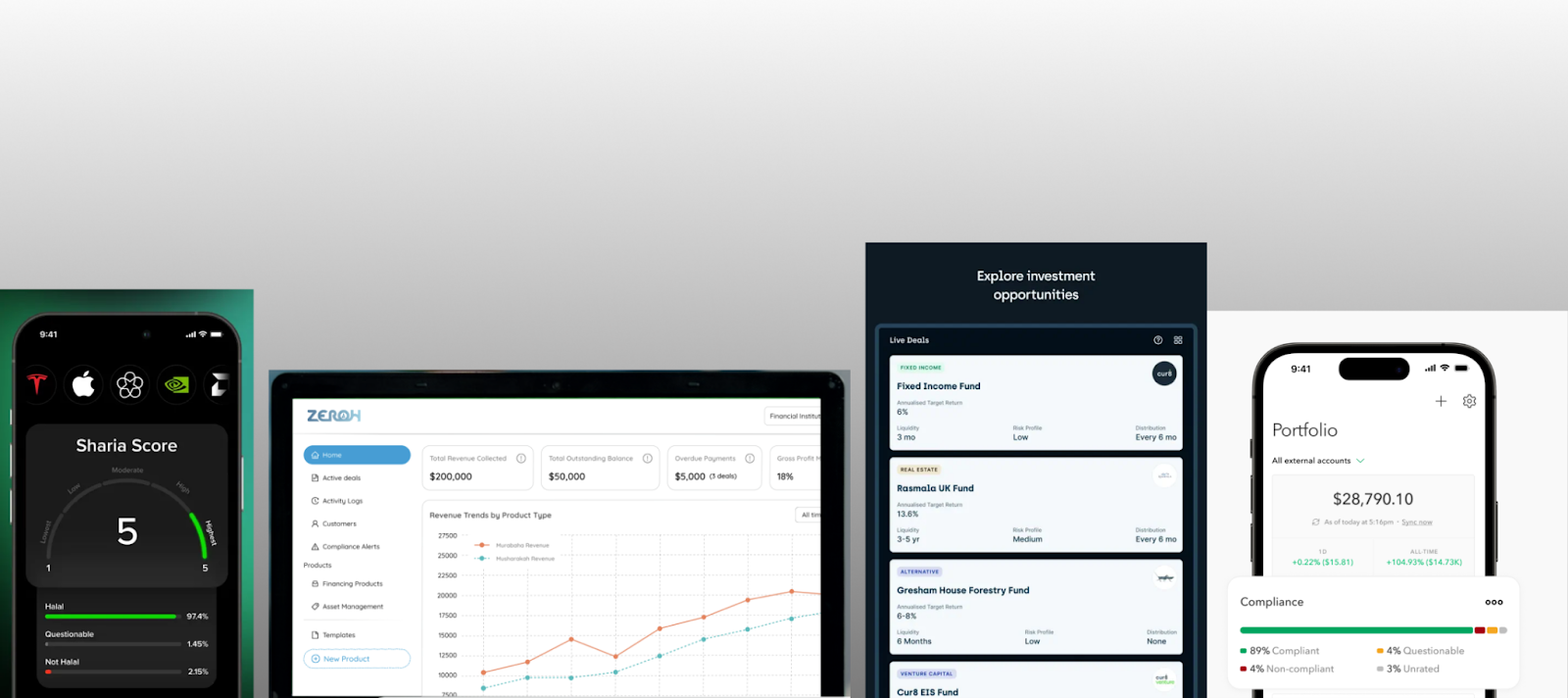
Illustrative interface. Screening labels and portfolio charts should be checked against the provider's current documents.
Banking, cash, and retirement accounts
Cash and deposits
Cash is where investment planning often meets a difficult operational question. A bank deposit, brokerage cash sweep, money market mutual fund, and short-term sukuk fund are not the same product. Ask where the money sits, whether it earns interest, who holds it, what risks apply, and how readily it can be withdrawn.
The FDIC explains that eligible deposits at an insured bank can be covered under its rules, while stocks, mutual funds, and other non-deposit investments are not FDIC-insured. Deposit insurance protects against an insured bank failure within coverage limits; it does not certify Shariah compliance. Conversely, a Shariah review does not provide deposit insurance.
IRAs and workplace plans
An IRA or 401(k) is an account with its own tax rules, not a Shariah label for the investments inside it. A retirement account may offer screened funds or allow a brokerage window; another plan may have a narrow menu. Review the actual holdings, cash treatment, fees, and plan restrictions. The IRS describes traditional and Roth IRAs and their different tax treatment. Tax suitability is personal, and an account's tax advantage does not determine whether its underlying investments meet an investor's Shariah standard.
Islamic home financing is a separate decision
U.S. home-financing providers may use a cost-plus sale, a lease-based structure, or a declining co-ownership arrangement. These are often described as murabaha, ijara, and musharaka. The Chicago Fed's historical review explains the broad mechanics, but the name of a contract does not tell you its precise legal and economic terms.
Ask who owns the home at each stage; who is responsible for taxes, insurance, maintenance, and casualty loss; whether the payment can change; what happens after a late payment or early payoff; and how the arrangement is funded or transferred. Compare the total amount payable, upfront charges, monthly obligations, and exit terms. If a lender provides a Loan Estimate or Closing Disclosure, the Consumer Financial Protection Bureau's guide can help you read the cost fields. A qualified attorney and Shariah adviser can help interpret the specific contract. NoorVest's investment advisory services should not be mistaken for an endorsement of any home-financing provider.
How to examine a Shariah claim
“Shariah-compliant” can refer to a screened index, an adviser-supervised investment process, a fund-specific opinion, or a review of a financing contract. Those are different claims. Before relying on one, look for the named standard, the reviewing body, the scope of its opinion, the date, and a process for monitoring changes. An AAOIFI-aligned methodology is not the same as direct certification by AAOIFI. Our AAOIFI standards guide explains the distinction.
For listed shares, NoorVest's published AAOIFI-aligned methodology excludes prohibited primary business activities and applies three financial screens: interest-based debt divided by market capitalization below 30%; interest-earning deposits and securities divided by market capitalization below 30%; and prohibited-activity income divided by total income below 5%. Incidental prohibited income that passes the threshold is addressed through purification rather than treated as permissible income to keep. Listed securities are reviewed quarterly, and the portfolio process includes cash-only trading controls. These are NoorVest's published rules, not a claim that every Shariah board uses the same thresholds.
On February 3, 2026, the Shariah Supervisory Board of Amanie Advisors issued a pronouncement concerning the NoorVest platform and the documents it reviewed. Its scope is specific. It does not approve unrelated providers, guarantee future compliance of every holding, or protect against market loss. Investors can inspect the pronouncement and operational details on NoorVest's certification page.
A practical comparison checklist
Identify the product. Is it common stock, a fund, a deposit, a financing contract, or another instrument? Do not assume the same analysis applies to each.
Read the source documents. For a fund, use its current prospectus, holdings, index methodology, and Shariah documents. For financing, obtain the full contract and required cost disclosures.
Verify oversight. Who made the Shariah determination, what did they review, when was it issued, and how are changes handled?
Compare all costs. Include advisory fees, fund expenses, trading spreads, custody charges, financing charges, and exit terms where relevant.
Assess financial risk. Consider concentration, liquidity, volatility, credit exposure, and possible loss of principal. Religious screening is not a risk-control guarantee.
Check account and tax fit. The same investment can have different consequences in a taxable account, IRA, or employer plan. Seek qualified tax advice for your circumstances.
Plan for review. Holdings, ratios, product terms, and personal needs change. Decide how often you will revisit them.
NoorVest combines halal investment management with financial planning. Its published process screens listed securities, monitors compliance, reports purification information, and reviews portfolio decisions in light of a client's objectives, time horizon, liquidity, taxes, and risk tolerance. Fee arrangements and service scope should be read in the current advisory documents and pricing page. NoorVest is not a bank or home-financing provider.
Frequently Asked Questions
Is Islamic finance legal in the United States?
Financial providers can offer products structured around Islamic principles while complying with applicable U.S. law. The legal analysis is product-specific. Historical OCC decisions considered particular bank financing structures; they were not a general religious approval of every product marketed as Islamic.
Is a halal ETF the same as a Shariah-compliant bank account?
No. An ETF is an investment that can lose value and is not FDIC-insured. A deposit account has different legal protections and cash characteristics. Each also needs its own Shariah analysis.
Can I use an IRA for halal investing?
An IRA's tax status does not itself determine whether its holdings meet a Shariah methodology. Check the investment choices, cash sweep, account fees, and the tax rules applicable to you.
Do all halal funds follow AAOIFI standards?
No. Fund sponsors can use different Shariah standards, index rules, review cycles, and purification methods. Read the fund's own methodology and supervisory documents rather than inferring its rules from the word “halal.”
Does Shariah screening make an investment safer?
No. Screening addresses compliance under a stated methodology. A screened investment can be concentrated, volatile, illiquid, or exposed to business and market losses. Diversification may reduce some risks but cannot prevent loss.
How do I compare Islamic home-financing offers?
Read the full contracts and compare ownership, monthly and total payments, fees, maintenance obligations, late-payment terms, early payoff, and the scope of Shariah review. A qualified legal and religious adviser can assess the documents with you.
The bottom line
The useful question is not whether “Islamic finance” has reached a certain size in America. It is whether a specific account, investment, or contract meets the standard you follow and fits the financial job you need it to do. Good diligence begins with the actual documents, a named review process, transparent costs, and a realistic view of risk.
If you would like to discuss how Shariah-conscious investing fits within a broader plan, NoorVest offers an introductory conversation. A conversation does not establish an advisory relationship or mean that any particular product is appropriate for you.
Important disclosure
This article is educational and may be considered an advertisement for NoorVest's advisory services. It is not individualized investment, tax, legal, or religious advice; an offer to buy or sell a security; or an endorsement of a named third-party product. Investments can lose principal. Fund holdings, costs, availability, and Shariah assessments may change. Review current issuer documents and consult qualified professionals before acting.
About the author
Tarif Homsi is NoorVest's Founder and CEO. His background includes more than a decade advising high-net-worth families at J.P. Morgan Private Bank and UBS.