Dr. Kareem had always been meticulous with his numbers. As a highly successful orthopedic surgeon in Chicago, his financial life was a masterclass in modern diversification. He possessed a maxed-out 401(k), a robust portfolio of tech equities, a series of angel investments in healthcare startups, and a handful of commercial real estate syndications. He was also a deeply generous man. Whenever a GoFundMe linked to a medical crisis in a war-torn region crossed his WhatsApp, he donated immediately. When his local masjid announced a multimillion-dollar fundraiser for a new youth center, he wrote a substantial check.
Yet, every year during the last ten days of Ramadan, Kareem felt a creeping sense of anxiety. Staring at a labyrinth of glowing spreadsheets on his monitor, he tried to untangle exactly how much of his complex, modern portfolio was subject to Zakat. He knew exactly what his tax burden was to the IRS down to the decimal point, guided by his CPA. But his duty to Allah and to not-so well-off fellow muslims —his Zakat—was essentially an educated guess. He realized an uncomfortable truth that kept him awake: he had completely mastered the art of accumulating wealth, but he was struggling with the science of purifying it
Dr. Kareem’s story is the story of the modern, educated American Muslim. We have achieved unprecedented levels of financial success, yet we often subconsciously conflate general charity (Sadaqah) with our divine, mathematical obligation (Zakat). To truly build a legacy that matters, we must understand why Zakat is not just another form of giving, in fact it is the foundation of a pure portfolio and the ultimate wealth strategy
The Superiority of Zakat: It Is a Liability, Not a Gift
When we drop a twenty-dollar bill into a donation box or write a check to a local food bank, we experience the warm, psychological glow of philanthropy. This is Sadaqah—a voluntary, beautiful act of human generosity. But Zakat is fundamentally different, both legally and spiritually.
Linguistically, the word Zakat means "to purify." It is not a gift you are generously bestowing upon the poor; it is the poor’s rightful property that has been temporarily housed in your bank account by divine decree. If you do not surgically extract it, your entire pool of wealth becomes spiritually and ethically contaminated.
Think of it through the lens of modern corporate accounting. Sadaqah is the discretionary bonus you hand out to employees when your company has a highly profitable quarter. Zakat, however, is a non-negotiable liability on your balance sheet. You simply do not own that 2.5%. This makes an interesting difference: Zakat entirely removes the ego from philanthropy. It cures the wealthy of the dangerous illusion of absolute ownership, and in doing so, it cures society of the toxic disease of extreme wealth inequality. You are not a savior giving away your hard-earned money; you are a steward returning what was never yours to begin with.
The Economic Brilliance of the 2.5%
From a strict macroeconomic perspective, Zakat is a masterstroke of systemic economic design. Modern Western tax systems primarily tax income and capital gains. If you earn a million dollars but hide it under your mattress or lock it away in a stagnant vault, the government largely leaves that capital alone.
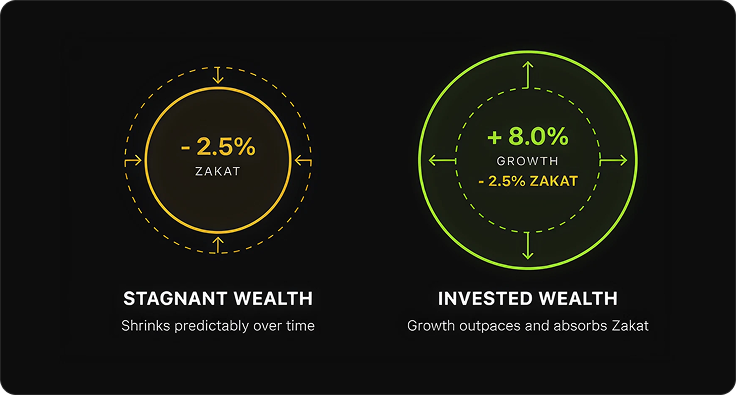
Zakat, conversely, mobilizes stagnant wealth. By levying a 2.5% annual mandate on hoarded, liquid capital, Islamic economics effectively re-distributes idle money. If you simply sit on a pile of cash, Zakat will slowly and mathematically put it back into the economy over time. Therefore, Zakat forces the wealthy to actively deploy their capital: to invest in businesses, real estate, and innovations that generate a return exceeding 2.5% just to break even. It forces money out of vaults and into the broader economy, creating jobs, funding research, and driving systemic innovation.
American Muslims are already a powerhouse of economic circulation. According to the Muslim Philanthropy Initiative at Indiana University, American Muslims donate an estimated $1.8 billion annually to charity, with Zakat making up a massive, foundational pillar of those funds. We are an incredibly generous demographic, giving more per capita than almost any other group. But as our portfolios become more complex, our execution of Zakat must evolve from simple cash calculations to sophisticated wealth management.
Building a Pure Legacy with Halal Infrastructure
This is where sophisticated, faith-based infrastructure becomes a necessity rather than a luxury. You need a financial system that seamlessly aligns your religious obligations with institutional-grade growth.
This is precisely why we built NoorVest. Our platform was designed to ensure that your financial affairs are meticulously planned and coordinated, allowing you to focus on what matters most: your family, your career, and your impact.
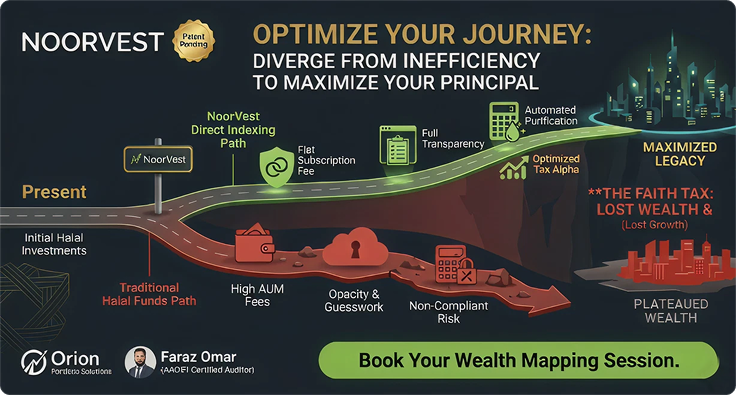
Instead of relying on opaque mutual funds, we utilize Halal Custom Indexing. This builds your portfolio by directly owning each individual Halal-compliant stock that would have been inside a traditional fund. Because you directly own the assets in your own name, Zakat calculation transforms from a frustrating, spreadsheet-induced guessing game into a precise, transparent metric.
To help you visualize this clarity right now, we’ve made our calculation engine open to the public; you can determine your exact spiritual liability in minutes using our tool at zakat.noorvest.com.

By merging world-class tax-efficiency with uncompromising, AAOIFI-certified Shariah screening, NoorVest ensures that your wealth is clean from the moment it is invested to the moment you calculate your Zakat.
A World Transformed: The Billionaire Zakat Scenario
To truly grasp the revolutionary, world-altering nature of Zakat, we must contrast it with the modern billionaire’s approach to philanthropy. Imagine, for a moment, what the global economy would look like if the wealthiest individuals on earth—titans like Elon Musk or Jeff Bezos—were mandated to distribute their wealth according to exact Islamic principles.
Currently, elite philanthropy is largely a vehicle for tax optimization, public relations, and legacy-building ego. Wealthy individuals sign pledges to give their fortunes away "over their lifetime," often funneling billions into Donor-Advised Funds (DAFs) or private family foundations. In these structures, the capital remains under their ultimate control, appreciating tax-free, while only a minuscule fraction trickles down to actual charitable causes on a timeline entirely of their choosing. They fund vanity projects, prestigious university wings, or space exploration, while systemic, grinding poverty remains untouched in their own cities. Philanthropy today operates entirely on the billionaire's schedule.
Zakat operates on a divine deadline.
If Jeff Bezos or Elon Musk—each hovering around a net worth of $200 billion—were subject to the exact mathematical rules of Zakat, the reality is staggering. A 2.5% levy on their wealth and liquid assets means they would each be required to liquidate and distribute approximately $5 billion every single year.
But the miracle of Zakat isn't just in the monetary amount; it is in the strict destination. Zakat cannot be put into a trust fund for a modern art museum. Islamic law dictates exactly where these funds must go: directly to the absolute poorest, the destitute, stranded travelers, and those drowning in debt
If the world’s billionaires paid a literal 2.5% wealth tax directly to the bottom tier of society annually, absolute global poverty would be eradicated within a decade. We would witness an unprecedented debt jubilee, many people who practically fall below poverty lines just because they suffering one medical emergency would live a debt-free happy life.
Furthermore, this immediate injection of liquid capital into the lower economy would cause a massive grassroots economic boom based on the economic principle of the "velocity of money." The poor do not hoard capital; they spend money immediately on basic human needs—housing, food, healthcare, and education. This drives massive demand, stimulating the economy from the ground up, rather than waiting decades for wealth to supposedly "trickle down" from elite foundations.
Zakat does not seek to destroy wealth; it actively encourages the creation of it. But it relentlessly seeks to destroy the hoarding of wealth. It cures the resentment between socioeconomic classes and restores human dignity to those who have been marginalized by modern capitalism.
Building a Pure Legacy with Halal Infrastructure
Your wealth is an Amanah, it is a sacred trust handed to you for a temporary, fleeting period. How you grow it, how you protect it, and how you eventually purify it will be your ultimate, eternal legacy. We are the educated, high-earning, and well-resourced generation of Muslims in American history. It is time we upgrade our financial mindsets to match the depth and sophistication of our faith.
We must stop viewing Zakat as a charitable afterthought, hastily calculated in the final days of Ramadan, and start treating it as the foundational pillar of our long-term financial planning.
If your financial life looks like Dr. Kareem’s (spanning 401(k)s, private equity, and real estate, for example) a standard web calculator may not capture the full complexity of your assets. Precision requires a strategy. We invite you to book a complimentary Wealth Mapping Session with our advisory team.
If your financial life looks like Dr. Kareem’s (spanning 401(k)s, private equity, and real estate, for example) a standard web calculator may not capture the full complexity of your assets. Precision requires a strategy. We invite you to book a complimentary
Wealth Mapping Session with our advisory team.
In this private consultation, we will walk you through exactly how our infrastructure works, help you calculate your precise Zakat liability across your entire portfolio, and answer any questions you have about transitioning to institutional-grade, completely Halal wealth management. Stop guessing, and let us build your blueprint.
But the miracle of Zakat isn't just in the monetary amount; it is in the strict destination. Zakat cannot be put into a trust fund for a modern art museum. Islamic law dictates exactly where these funds must go: directly to the absolute poorest, the destitute, stranded travelers, and those drowning in debt
If the world’s billionaires paid a literal 2.5% wealth tax directly to the bottom tier of society annually, absolute global poverty would be eradicated within a decade. We would witness an unprecedented debt jubilee, many people who practically fall below poverty lines just because they suffering one medical emergency would live a debt-free happy life.
Furthermore, this immediate injection of liquid capital into the lower economy would cause a massive grassroots economic boom based on the economic principle of the "velocity of money." The poor do not hoard capital; they spend money immediately on basic human needs—housing, food, healthcare, and education. This drives massive demand, stimulating the economy from the ground up, rather than waiting decades for wealth to supposedly "trickle down" from elite foundations.
Zakat does not seek to destroy wealth; it actively encourages the creation of it. But it relentlessly seeks to destroy the hoarding of wealth. It cures the resentment between socioeconomic classes and restores human dignity to those who have been marginalized by modern capitalism.
When you look at your portfolio today, are you simply seeing a monument to your own success, or are you looking at the purified foundation of your ultimate legacy?
